


What Is a RO/RO Vessel? How It Works, Suitable Cargo and Routes in Vietnam
A RO/RO (Roll-on/Roll-off) vessel carries wheeled cargo that is driven or towed on and off via a ramp, with no cranes involved. Suitable cargo: cars, trucks, construction machinery, and non-wheeled cargo placed on specialized roll trailers (mafi). In Vietnam, RO/RO vessels regularly call at Tan Vu (Hai Phong) and Ho Chi Minh City.
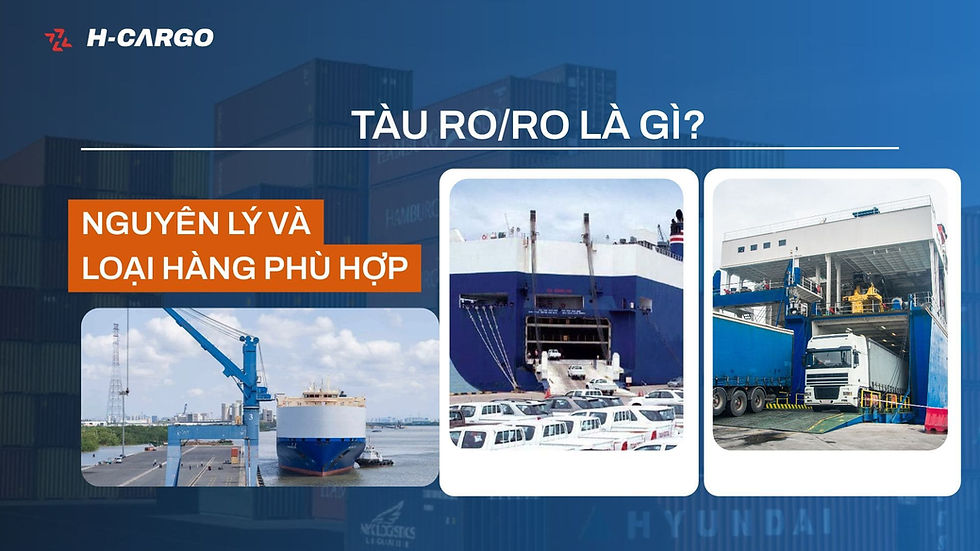
Table of contents:
I. What is a RO/RO vessel and how does it work?
A RO/RO vessel loads and discharges horizontally: cargo is driven or towed over a stern or side ramp, then parked and lashed on the vessel's decks. Container ships and bulk carriers, by contrast, load and discharge vertically with cranes.
With no crane lifting, the risk of impact damage during handling is lower. The trade-off is that every vessel has hard limits on ramp capacity, door height and deck height. Cargo that exceeds these limits cannot be loaded, even if the vessel has space.
II. What types of RO/RO vessels are there?
For project cargo, the type to focus on is the PCTC because it has strengthened decks and liftable (hoistable) decks.
Vessel type | Main cargo | Key point for heavy cargo |
PCC (Pure Car Carrier) | Passenger cars | Low decks, not ideal for tall vehicles |
PCTC (Pure Car and Truck Carrier) | Trucks, construction machinery, cargo on mafi | Example: the vessel Don Pasquale (Wallenius): 125-tonne stern ramp, 7.0 m wide, 3 of 13 decks are hoistable |
ConRo | Containers and rolling cargo | Example: ACL's G4 vessels: 3,800 TEU and 28,900 m² of RO/RO deck space |
RoPax | Passengers and vehicles | Short ferry routes, rarely relevant to project cargo |
Specifications vary widely between vessels: Höegh Autoliners' New Horizon class has a 375-tonne ramp and accepts cargo up to 6.5 m high and 12 m wide. That is why you need to check against the specific vessel name, not ask about "RO/RO vessels" in general.
III. Which cargo should go RO/RO, and which should not?
RO/RO suits self-propelled wheeled or tracked cargo best, as well as heavy, long cargo that can be placed on a mafi.
Consider RO/RO for:
Cars, trucks, tractor units, semi-trailers and special-purpose vehicles.
Excavators, bulldozers, wheeled cranes and crawler cranes.
Transformers, plant equipment and steel structures placed on a mafi (roll trailer). Wallenius Wilhelmsen roll trailers take up to 140 tonnes; Höegh Autoliners roll trailers take up to 160 tonnes.
Choose another option when:
The cargo is small and packed in large quantities: containers are cheaper.
Packages exceed the ramp or door limits of vessels serving the route: switch to break bulk.
No RO/RO vessel calls at the port of loading or the port of discharge.
IV. What must a shipment meet to be loaded?
RO/RO carriers approve each shipment before accepting a booking. Prepare the following information:
Requirement | What to prepare | Risk if missing |
Dimensions and weight | Length × width × height, actual weight, centre of gravity | Rejected at the port |
Rolling capability | Self-propelled, towable, or must be placed on a mafi | Extra mafi and tractor costs |
Lashing points | Location of lashing points on the cargo or cradle | Fails safety requirements |
Cargo condition | Photos, drawings; for vehicles: fuel, battery and EV battery levels as required by the carrier | Must be reworked to the specific carrier's requirements (especially for electric vehicles) |
Road leg after discharge | Dimensions and weight of the full vehicle combination | Road circulation permit required |
Road leg after discharge: a vehicle combination (including cargo) over 48 tonnes, or longer than 20.0 m, wider than 2.5 m or higher than 4.2 m (4.35 m for container trucks) is classed as oversized/overweight under Circular 12/2025/TT-BXD (amended by Circular 19/2026/TT-BXD) and needs a circulation permit issued by the provincial Department of Construction.
Related articles:
- Barges and pontoons for heavy cargo: when should you go by water instead of road?
- What is an Open Top container? Specs for 20', 40' and top-loading
V. How does RO/RO differ from Flat Rack and break bulk?
RO/RO fits when cargo can roll and the route has RO/RO service; Flat Rack fits moderately oversized cargo; break bulk is for packages that exceed both.
Criteria | RO/RO | Flat Rack (container) | Break bulk |
Handling | Rolled over a ramp | Container crane | Ship's gear or shore crane |
Suitable cargo | Vehicles, construction machinery, cargo on mafi | Moderately oversized machinery | Very heavy, very large packages |
Main limits | Ramp, doors, deck height | Flat Rack payload and dimensions | Crane capacity, port draft |
Frequency | RO/RO vessel schedule | Container network | Per voyage |
VI. Which ports in Vietnam handle RO/RO vessels?
The two hubs with public 2026 data are Tan Vu port (Hai Phong) and the Ho Chi Minh City port cluster.
Tan Vu, Hai Phong: received 61 RO/RO calls in 2025, about 70,000 vehicles; weekly RO/RO service since 07/2026 with NYK, K Line and ECL. On 14/05/2026, the vessel Procyon Leader (NYK) loaded 27 mafis carrying 43 oversized and heavy packages, showing that RO/RO is not only for cars.
Ho Chi Minh City: at noon on 02/01/2026, a vessel carrying 860 imported passenger cars berthed at Saigon Premier Container Terminal (SPCT, Hiep Phuoc). In 2025, Saigon Port Area 2 Border Customs cleared over 75,000 imported cars.
Several other ports receive RO/RO vessels on a per-voyage basis; check actual schedules with the carrier.
Schedules change with the season and with car manufacturers, so check the actual schedule when you have a shipment.
VII. What drives RO/RO shipping costs?
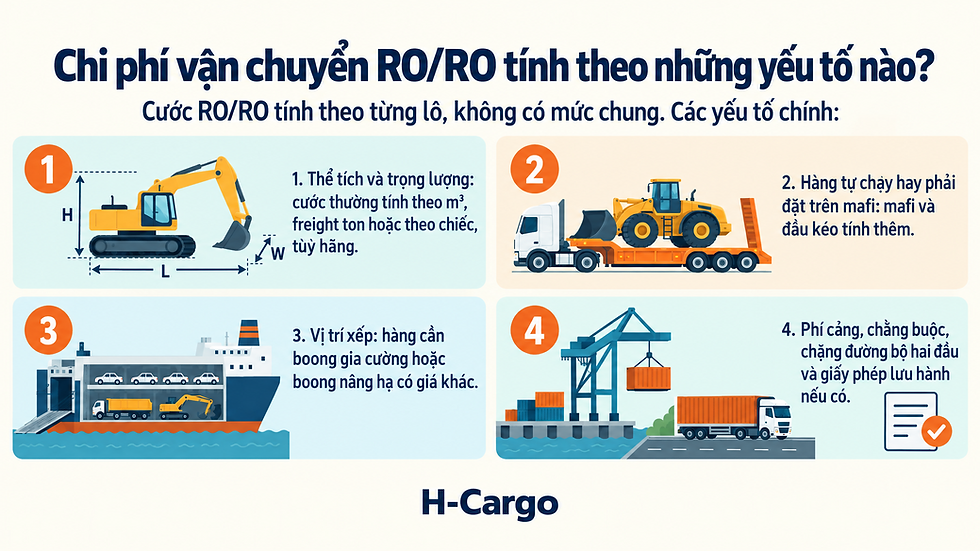
RO/RO freight is quoted per shipment, with no standard rate. The main factors:
Volume and weight: freight is usually charged per m³, per freight ton or per unit, depending on the carrier.
Self-propelled or on a mafi: mafi and tractor charges are added.
Stowage position: cargo needing strengthened or hoistable decks is priced differently.
Port charges, lashing, road legs at both ends and circulation permits where required.
VIII. Frequently asked questions
Can a broken-down vehicle that won't start be shipped RO/RO?
Yes, as long as the wheels still roll and it can be towed. If it cannot roll, it must be placed on a mafi.
Can machinery without wheels be shipped RO/RO?
Yes, if it is placed on a mafi and the total load is within the capacity of the trailer and the vessel's ramp.
Is RO/RO cheaper than Flat Rack?
There is no general answer. Self-propelled vehicles are simpler on RO/RO because no container is needed; compact machinery may be cheaper on Flat Rack. Compare quotes for the same shipment.
Does RO/RO cargo need lashing?
Yes. Cargo is lashed to lashing points on deck; cargo on a mafi is secured to the trailer, and the trailer is secured to the deck.
IX. Conclusion
A RO/RO vessel is worth considering when the cargo can roll, the route has vessel calls, and the shipment fits within the ramp, door and deck limits of the specific vessel. Three things to do before requesting a quote:
Re-measure dimensions, actual weight and centre of gravity, and photograph the lashing points.
Determine whether the cargo is self-propelled, towable or needs a mafi.
Plan the road leg after discharge: check whether it exceeds the oversized/overweight thresholds.
Send your cargo details and H-Cargo will propose a solution through our RO/RO shipping service and oversized and heavy-lift cargo transport to the project site.
Author: Navy Ngo - Project team
Contact us for a free consultation:
H-Cargo International Logistics
113-115 Ung Van Khiem St., Ward Thanh My Tay, Ho Chi Minh City
Tel: +84 888 909 186
Email: project@hcargovn.com
Web: www.hcargovn.com


Comments