


What Is an Open Top Container? 20' and 40' Specs and How to Load From the Top
An Open Top container has four steel walls and a floor like a dry container, but its roof is a removable frame covered with a tarpaulin, so cargo can be crane-loaded from above. It is used for over-height cargo that does not fit through standard container doors, or cargo that can only be loaded by crane.

Table of contents:
I. What is an Open Top container and how does it differ from a dry container?
The difference is at the top: instead of a fixed steel roof, an Open Top has removable roof bows and a tarpaulin. The crossbeam above the doors (door header) swings open, making it easier to bring tall cargo in through the doors.
The two side walls and the floor remain, so cargo is better protected than on a Flat Rack. Lashing rings on the top side rails, bottom rails and corner posts each hold about 1,000 kg according to TIS (German Insurance Association - GDV).
II. What are the dimensions and payload of an Open Top container?
Specifications vary by carrier and by container build series. The table below shows figures published by Hapag-Lloyd (checked 20/10/2026), for reference when planning:
Specification | 20' Open Top | 40' Open Top | 20' Open Top High Cube |
Internal length × width | 5,895 × 2,350 mm | 12,029 × 2,350 mm | 5,892 × 2,347 mm |
Internal height | 2,340 mm | 2,344 mm | 2,648 mm |
Roof opening (length × width) | 5,338 × 2,230 mm | 11,552 × 2,230 mm | 5,391 × 2,227 mm |
Max payload | 30,050 kg | 28,450 kg | 27,970 kg |
Volume | 32.5 m³ | 66.8 m³ | 36.8 m³ |
The two figures that matter most:
The roof opening is narrower than the interior by about 12 cm. Cargo lowered from above must pass through this opening, not just fit the interior.
A 40' Open Top has a much lower payload than a 40' Flat Rack. For heavy cargo that is not tall, consider a Flat Rack.
When booking, always ask the carrier for the specifications of the exact container they will release.
III. Which cargo should ship in an Open Top container?
Open Top suits tall cargo or cargo that can only be loaded by crane, as long as its width fits inside the container.
Machinery and equipment taller than a dry container door.
Heavy blocks, coils and large wooden crates that need to be lowered straight onto the floor by crane.
Cargo that would be damaged if dragged through the doors by forklift.
Do not use Open Top when the cargo is wider than the container interior or too heavy for its payload. In those cases, Flat Rack or break bulk is a better fit.
Related articles:
- What is a RO/RO vessel? How it works, suitable cargo and routes in Vietnam
-  Multimodal transport for project cargo: when to combine sea, barge, road and rail?
IV. How do you load an Open Top container?
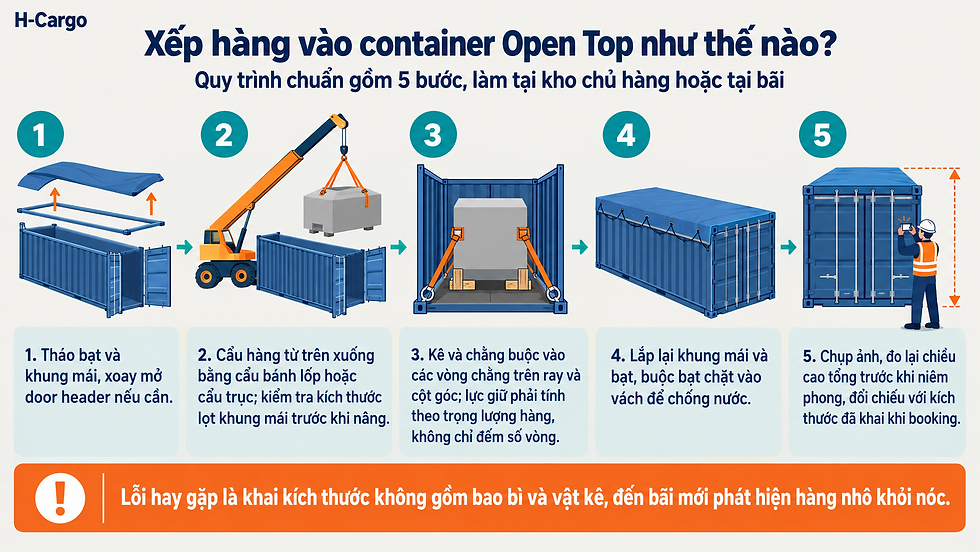
The standard process has 5 steps, done at the shipper's warehouse or at the container yard:
Remove the tarpaulin and roof bows, and swing open the door header if needed.
Lower the cargo from above with a mobile crane or overhead crane; check that it clears the roof opening before lifting.
Dunnage and lash to the lashing rings on the rails and corner posts; securing force must be calculated from the cargo weight, not just the number of rings.
Refit the roof bows and tarpaulin, tying the tarpaulin tightly to the walls to keep water out.
Photograph and re-measure the overall height before sealing, and compare with the dimensions declared at booking.
A common mistake is declaring dimensions without packaging and dunnage, only to find at the yard that the cargo sticks out above the roof.
V. How is over-height cargo handled?
Cargo taller than the container walls can still ship in an Open Top, but it becomes out-of-gauge (OOG) cargo with these consequences:
The standard roof bows cannot be refitted; a made-to-measure tarpaulin must be tied around the cargo.
The carrier must stow the container on top with nothing stacked above, so it usually charges extra for the lost slots.
Handling at the port may require a special lifting frame instead of standard lifting, adding cost.
How much over-height a carrier accepts depends on the carrier and the vessel, so get approval before booking.
According to TIS (GDV), the roof bows of an Open Top also help stabilize the container, so for cargo that is well over height, a Flat Rack is usually the better choice.
Have cargo taller than a container door that needs an Open Top? Send the dimensions (including packaging), weight and POL/POD, and H-Cargo will check the right container type. Get a quote
VI. When should you choose Flat Rack instead of Open Top?
Choose Flat Rack when the cargo is wider than the container interior, or heavier than the Open Top payload. Choose Open Top when the cargo is only over height and needs protection on four sides.
A full comparison of dimensions, payload and cost between Open Top, Flat Rack and break bulk vessels is in our article on choosing break bulk, Flat Rack or Open Top for oversized cargo. For very heavy cargo that must travel by road after discharge, see hydraulic multi-axle trailers and SPMT.
VII. What information do you need to book an Open Top container?
Information | Why it is needed |
Length × width × height of each package, including packaging and dunnage | Confirms whether it clears the roof opening and whether it is over height |
Weight and centre of gravity of each package | Checks against payload and calculates lashing |
Photos or drawings, lifting points | Plans the top-loading lift |
Stuffing location and available lifting equipment | Decides whether to stuff at the warehouse or at the yard |
POL, POD, required shipping date | Checks carrier availability of containers and vessels accepting OOG |
VIII. Frequently asked questions
Is an Open Top container rainproof?
Yes, when the tarpaulin is fitted correctly and tied tightly. Over-height cargo uses a custom tarpaulin, so check it more carefully and consider moisture-proof packing.
How tall does cargo need to be to require an Open Top?
When the cargo is taller than a dry or High Cube container door but still needs to go inside the container. Measure including packaging to decide.
Is an Open Top more expensive than a dry container?
Usually yes, because there are fewer of these containers and they need crane handling and lashing. If the cargo is over height, the cost rises further because of lost slots on the vessel.
Can cargo wider than the container ship in an Open Top?
No. The side walls stay in place, so width is limited by the container interior. Over-width cargo must go on a Flat Rack.
How does an Open Top High Cube differ from a standard Open Top?
The High Cube version is about 30 cm taller inside (2,648 mm vs 2,340 mm per Hapag-Lloyd figures), suiting cargo just slightly taller than a standard Open Top and avoiding over-height handling. These units are scarce, so ask the carrier early.
IX. Conclusion
An Open Top container is the right choice when cargo is too tall or must be crane-loaded from above, yet still fits within the container's width and payload. Three things to do before booking:
Measure including packaging and compare with the roof opening, not just the container interior.
Check the weight against the payload of the exact Open Top type the carrier will release.
If the cargo is over height, get carrier approval in advance and prepare a custom tarpaulin.
H-Cargo can help check your options through our out-of-gauge (OOG) cargo shipping service.
Author: Navy Ngo - Project team
Contact us for a free consultation:
H-Cargo International Logistics
113-115 Ung Van Khiem St., Ward Thanh My Tay, Ho Chi Minh City
Tel: +84 888 909 186
Email: project@hcargovn.com
Web: www.hcargovn.com


Comments