


Multimodal Transport for Project Cargo: When to Combine Sea, Barge, Road and Rail
Multimodal transport for project cargo means moving oversized equipment by at least two modes of transport under a single contract. In Vietnam, the most common combination is sea plus road or barge. Rail should only be added when the route, stations and wagon loading gauge allow it.

Table of contents:
I. What is multimodal transport?
Under Decree 87/2009/ND-CP (as amended, consolidated text 39/VBHN-BXD of 2026), multimodal transport is the carriage of goods by at least two different modes on the basis of a single multimodal transport contract.
Instead of hiring each leg separately, the shipper signs with one party, the multimodal transport operator (MTO). The MTO issues the multimodal transport document and is liable from taking charge of the goods until delivery (Article 17).
II. Why does project cargo almost always move multimodally?
Because almost no single vehicle can go straight from an overseas factory to the project foundation. Vessels only reach the port, while project sites lie deep inside industrial parks, airports and power plants. On top of that, each mode has its own limits:
Road: a vehicle combination (including cargo) over 48 tonnes, or longer than 20.0 m, wider than 2.5 m or higher than 4.2 m, is oversized/overweight cargo and needs a circulation permit from the provincial Department of Construction (Circular 12/2025/TT-BXD, amended by Circular 19/2026/TT-BXD).
Weak bridges: some sections do not allow overloaded vehicles, forcing a switch to barge.
Port cranes: lifting capacity decides whether cargo is lifted directly from vessel to truck or goes via the yard.
III. What multimodal combinations are used for project cargo?
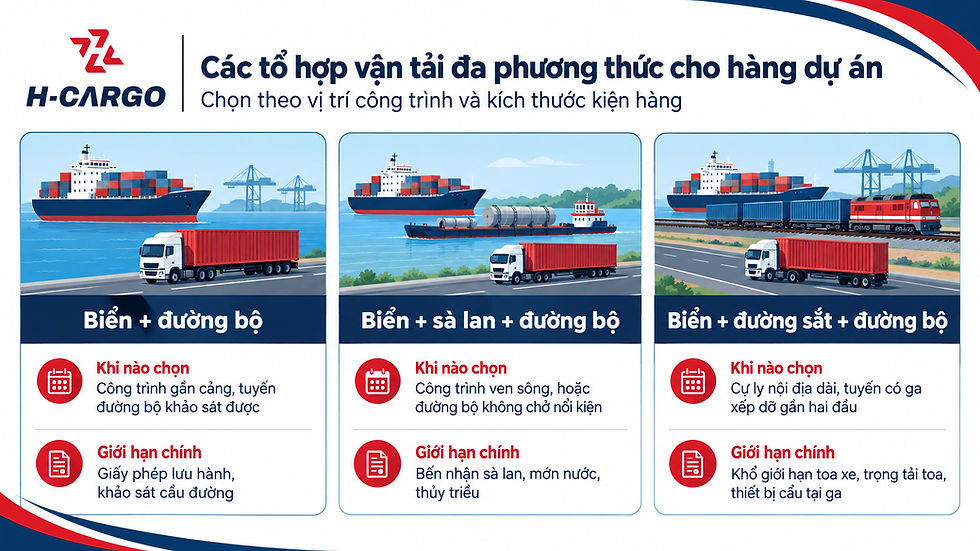
Choose based on the project location and package dimensions:
Combination | When to choose | Main limits |
Sea + road | Project site near the port, road route can be surveyed | Circulation permit, road and bridge survey |
Sea + barge + road | Riverside project site, or roads cannot carry the package | Barge landing, draft, tides |
Sea + rail + road | Long inland distance, loading stations near both ends | Wagon loading gauge, wagon capacity, lifting equipment at stations |
IV. When should rail be part of the plan?
When the inland distance is long, the package fits within the wagon loading gauge and there are loading stations near both ends. If any one condition is missing, transshipment costs at both stations usually wipe out the advantage.
The current legal framework includes Railway Law No. 95/2025/QH15 (effective 01/01/2026), Decree 16/2026/ND-CP and Circular 33/2025/TT-BXD on the management and operation of rail transport (effective 01/01/2026, replacing Circular 22/2018/TT-BGTVT).
Under Circular 33/2025/TT-BXD, a plan to carry oversized and overweight cargo by rail must be approved by the railway infrastructure operator before it is carried out.
Loading gauge, axle load, loading stations and running times vary by line, so check with the rail operator before finalizing the plan.
Related articles:
- What is an Open Top container? Specs for 20', 40' and top-loading
V. How has H-Cargo handled a multimodal project shipment?
One of the project shipments H-Cargo has handled:
POL: Santander, Spain
POD: Tan Vu, Hai Phong
Commodity name: Passenger boarding bridge
Volume: 21 packages, 130 tonnes in total
Scope of work: Port handling at Tan Vu, import customs clearance, door delivery to Noi Bai International Airport
This shipment had three consecutive legs: ocean freight from Europe, port handling in Hai Phong, then road transport to the airport, all coordinated by one party.
Have equipment that needs to travel several legs to your project site? Send the dimensions, weight, pickup and delivery points, and H-Cargo will survey the options. Get a quote
VI. Who is liable when cargo moves across several legs?
The multimodal transport operator is liable for the entire journey, including legs run by other parties.
To provide international multimodal transport, a company needs a licence issued by the Ministry of Construction (valid for 5 years), must maintain minimum assets equivalent to 80,000 SDR or an equivalent guarantee, and must hold professional liability insurance (Articles 5 and 6, Decree 87/2009/ND-CP, as amended by Decree 14/2026/ND-CP).
When choosing a partner, ask clearly: who signs the end-to-end contract, who issues the transport document, and which legs the insurance covers.
VII. What should shippers prepare for a route survey?
Missing input data is the main reason plans have to be redone. Prepare in advance:
Information | Why it is needed |
Dimensions and weight of each package (including packaging), centre of gravity, lifting points | Selecting the vessel, barge, truck or wagon |
Drawings or photos of the packages | Planning lashing and cribbing |
Pickup point, delivery point, site layout | Route survey, lifting and set-down area |
Incoterms, required delivery date | Who is responsible for which leg |
Customs clearance and insurance requirements | Combining all services into one contract |
VIII. Frequently asked questions
How does multimodal transport differ from hiring each leg separately?
Multimodal transport has one contract, one transport document and one party liable for the whole route. When hiring each leg, the shipper coordinates everything and handles disputes on its own.
Can rail carry oversized and overweight cargo?
It can, if there is a dedicated plan approved by the railway infrastructure operator. What is actually feasible depends on the loading gauge and stations on each line.
When should barge be used instead of road?
When the project site is near a river, the package exceeds the capacity of roads and bridges on the route, or strengthening the road would cost more than going by barge.
How long does it take to plan a multimodal project shipment?
It depends on whether a route survey and circulation permit are needed. A complete circulation permit application is processed by the Department of Construction within 2 working days.
IX. Conclusion
Project cargo rarely travels by a single mode. A good plan puts sea, barge, road and rail on the table at the same time, then chooses based on the project location and package size. Three things to do now:
Collect the dimensions, weight, centre of gravity and drawings of every package.
Confirm the actual delivery point and the lifting and set-down area at the site.
Choose one party liable for the whole route instead of piecing together separate contractors.
See H-Cargo's project cargo transport capabilities and the rules on oversized and overweight cargo by road.
Author: Navy Ngo - Project team
Contact us for a free consultation:
H-Cargo International Logistics
113-115 Ung Van Khiem St., Ward Thanh My Tay, Ho Chi Minh City
Tel: +84 888 909 186
Email: project@hcargovn.com
Web: www.hcargovn.com


Comments