


Oversized and Heavy-Lift (OOG) Cargo Transport in Vietnam: Regulations, Equipment and Handling Methods
Oversized and heavy-lift cargo (OOG – Out of Gauge) is indivisible cargo that, once loaded onto a vehicle, exceeds the permitted dimension or weight limits. Therefore, oversized and heavy-lift cargo transport requires a road permit, specialized equipment and a dedicated loading plan. In this article, H-Cargo summarizes the thresholds under current Vietnamese regulations, commonly used equipment and 5 loading/unloading methods at the port.
Table of contents:
I. What is oversized and heavy-lift (OOG) cargo?
II. What equipment is used to transport oversized and heavy-lift cargo?
III. How is oversized and heavy-lift cargo handled at the port?
IV. Frequently asked questions
V. Conclusion
I. What Is Oversized and Heavy-Lift (OOG) Cargo?
Oversized and heavy-lift cargo refers to single-piece packages, machinery or components that cannot be divided or dismantled; once loaded onto a vehicle, the overall dimensions or gross weight of the vehicle and cargo exceed the limits permitted on public roads.
Under Vietnam's 2024 Law on Road Traffic Order and Safety and Article 10 of Circular 12/2025/TT-BXD (effective from 01/07/2025, partly amended by Circular 19/2026/TT-BXD), the thresholds are as follows:
Cargo type | Criterion (vehicle and cargo combined) | Threshold |
Oversized cargo | Length | More than 20.0 m |
Oversized cargo | Width | More than 2.5 m |
Oversized cargo | Height from the road surface | More than 4.2 m (container vehicles: more than 4.35 m) |
Heavy-lift cargo | Gross weight of vehicle and cargo | More than 48 tonnes |
Exceeding just one of the dimension thresholds makes the cargo oversized.
1. Oversized cargo (out of gauge)
For oversized cargo, the main challenge lies in the route: overpass clearance, turning radii, lane width and toll stations. Depending on the actual dimensions, the road permit may include conditions on route, operating hours, pilot or escort vehicles, and require a route survey before transport.
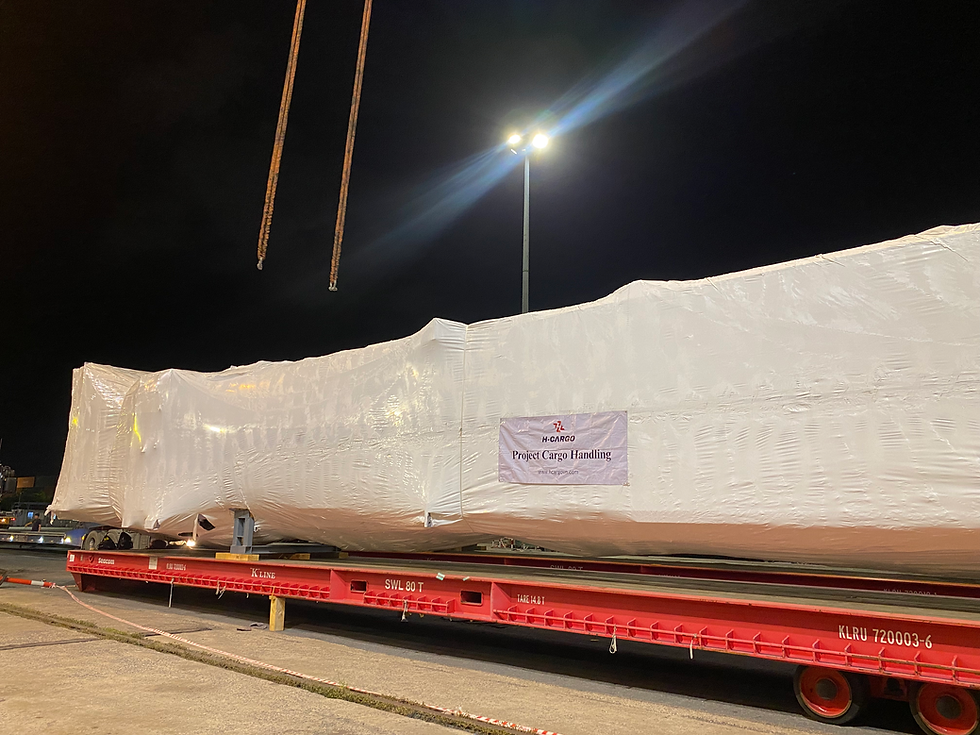
2. Heavy-lift cargo (overweight)
The heavy-lift threshold is based on the gross weight of vehicle and cargo (more than 48 tonnes), not just the package weight. When the load exceeds the capacity of roads and bridges on the route, bridge reinforcement, an alternative route or moving part of the journey to waterways may be required.

II. What Equipment Is Used to Transport Oversized and Heavy-Lift Cargo?
Every OOG package has its own characteristics. Depending on the route and infrastructure, H-Cargo usually recommends a combination of the following modes:
1. Road transport
Road transport delivers OOG cargo right to the factory or construction site (door to door). Commonly used equipment includes:
Flatbed trailer: carries long components such as steel beams, pipes and towers.
Lowbed trailer: the low deck reduces overall height, suitable for tall cargo such as transformers and tanks.
Multi-axle hydraulic modular trailer: couples multiple axles to distribute the load, used for very heavy packages.
Flat rack and open top containers: suitable for moderately oversized cargo moving on container routes.
Need a route plan and road permit? Send your package details for H-Cargo's advice.
2. Waterway transport
When a package is too heavy or too large for the load capacity of road bridges, waterway transport is often the better choice:
Barge: including hopper barges and pontoons, suitable for river routes, avoiding road and bridge weight restrictions.
Vessel: used for OOG import/export cargo or North – South routes; shipped on breakbulk vessels, specialized vessels or flat rack containers depending on package size.
III. How Is Oversized and Heavy-Lift Cargo Handled at the Port?
Stevedoring is the highest-risk stage for OOG cargo, so the lifting, cribbing and lashing plan must be calculated in advance for each package.
1. Lifting and auxiliary equipment
Depending on the load and work location, H-Cargo coordinates with the port and equipment rental providers to deploy shore cranes, ship's cranes, floating cranes or crawler cranes, together with suitable spreader bars, steel wire ropes, chains and webbing slings. Lifting equipment must be certified and inspected before use; worn or damaged gear must be removed.

2. Five OOG cargo handling methods at the port
For oversized and heavy-lift cargo, there are 5 common handling methods:
Vessel → Yard: lifting cargo from the vessel to the port yard pending customs clearance.
Yard → Truck: lifting cargo from the yard onto a trailer for delivery to the factory.
Vessel → Truck (direct delivery): lifting directly from the vessel onto a waiting trailer, reducing storage charges and the number of lifts.
Vessel → Vessel (ship-to-ship): lifting from the mother vessel onto a smaller vessel or barge; usually for transshipment cargo, rarely for import cargo requiring clearance at the port.
Yard → Vessel: loading the package onto a vessel, barge or pontoon by crane, or by self-propelled modular transporter (SPMT) using the Ro-Ro method.
3. Lashing and safety
Lashing determines the stability of the package throughout the journey. Lashing forces, lashing points and cribbing must be calculated according to the weight, center of gravity and dimensions of the package; even a small mistake can cause shifting, cargo damage or safety hazards.
That's why H-Cargo assesses ground conditions, selects suitable cribbing and equipment, applies the right lashing method for each cargo type and re-checks before the truck or vessel departs.

Related articles:
- Industrial tank transport
IV. Frequently Asked Questions
How many tonnes counts as heavy-lift cargo? When the cargo is indivisible and the gross weight of vehicle and cargo exceeds 48 tonnes (Article 10 of Circular 12/2025/TT-BXD).
Is a permit required to transport oversized and heavy-lift cargo? Yes. Vehicles carrying oversized or heavy-lift cargo on roads must have a road permit, which may include conditions on route, operating hours and escort vehicles.
Should OOG cargo go by road or by waterway? It depends on dimensions, weight, the load capacity of roads and bridges on the route and the factory location. Very heavy packages usually go by barge or vessel first, then a short road leg.
What information is needed for an OOG transport quotation? Length x width x height, weight, drawings or photos of the package, pickup and delivery points, and the required delivery date.
V. Conclusion
Oversized and heavy-lift cargo transport is an overall engineering task: correctly identifying thresholds under current regulations, selecting equipment, obtaining road permits and preparing loading and lashing plans for each package.
Before execution, businesses should do 3 things:
Survey the route: overpasses, bridge load ratings, turning radii and lifting locations.
Apply for road permits: prepare complete dimension, weight and transport plan data.
Confirm the loading and lashing plan: lifting equipment, cribbing and lashing points for each package.
H-Cargo supports you from consulting and planning to executing domestic and international project cargo and OOG transport. Send your package details to receive a suitable plan.
Author: Navy Ngo - Project team
Contact us for a free consultation:H-Cargo International Logistics
113-115 Ung Van Khiem St., Ward Thanh My Tay, Ho Chi Minh City
Tel: +84 888 909 186
Email: project@hcargovn.com
Web: www.hcargovn.com


Comments