


Break Bulk vs Flat Rack vs Open Top: Which Option Fits Your Oversized Cargo?
Break Bulk vs Flat Rack vs Open Top are the three main ocean shipping options for out-of-gauge (OOG) cargo and project cargo. Choose Open Top for cargo that only exceeds height, Flat Rack for cargo that exceeds width, and Break Bulk for super-heavy packages.
On power plant, wind farm, mechanical production line and industrial tank projects, choosing the wrong shipping mode at the planning stage can push total logistics costs up significantly. Worse, the cargo may be refused by the terminal (Terminal Reject) or stuck at the destination port because no suitable road vehicle is available to move it out. Drawing on hands-on experience from the H-Cargo International Logistics project team, this article breaks down the technical limits, cost structure and selection matrix for your shipment.

Table of contents:
I. How do Break Bulk, Flat Rack and Open Top differ?
Break Bulk, Flat Rack and Open Top differ fundamentally in the structure of the equipment, the stevedoring method at port, and the maximum dimensions and weight of each single package. Open Top and Flat Rack are special equipment containers carried on liner container vessels, while Break Bulk means loading each package directly into the hold or onto the deck of a specialized vessel.
To decide correctly, shippers need to know the technical specifications under the international standard ISO 668:2020 and the actual operating rules of major carriers such as Maersk, Hapag-Lloyd and CMA CGM.
1. Open Top container (OT): for over-height cargo or top loading by crane

An Open Top container keeps the four steel walls and load-bearing wooden floor of a standard dry container, but the fixed steel roof is replaced by removable roof bows and a waterproof tarpaulin.
Operational advantage: Suitable for machinery, wooden crates, cable reels or large glass panels whose width fits inside the container (under 2.34 m) but whose height exceeds the container door (about 2.28 m for a standard container, 2.58 m for a high cube), or for heavy cargo that cannot be pushed through the rear door by forklift and must be lowered from above by overhead crane.
Technical limits: According to equipment specifications published by carriers (Maersk for reference; figures may vary by carrier and equipment generation), a 20' Open Top has an internal length of 5.89 m, a width of 2.34 m and a max payload of about 28 tonnes; a 40' Open Top is 12.03 m long and 2.34 m wide, with a max payload of about 26.5 to 30 tonnes depending on the carrier.
2. Flat Rack container (FR): load-bearing equipment for over-width and over-length cargo
A Flat Rack container has a minimal design: a heavy-duty steel I-beam floor and two end walls, fixed or collapsible, with no side walls and no roof.

Operational advantage: Solves the problem of out-of-gauge cargo (OOG, cargo exceeding the internal dimensions of a standard container) in both width and height, or long cargo extending beyond the end walls when they are folded. With lashing rings along the side rails, each rated to the capacity the carrier publishes for that equipment type, Flat Rack is the first choice for construction machinery, pressure vessels, boilers and mid-size transformers.
Technical limits: Because the steel floor is thick to resist bending, the usable internal height of a 40' Flat Rack is only about 1.95 to 2.26 m (lower than a standard container). In return, the max payload at sea reaches 31 to 34.5 tonnes for a 20' Flat Rack and 40 to 47.3 tonnes for a 40' Flat Rack, depending on the carrier.
3. Break Bulk vessel: the solution for super-sized and super-heavy components

Break Bulk (general cargo shipped as individual packages) does not use containers; each unitized package is lifted directly into the hold (under deck) or onto the deck (on deck) of a multi-purpose vessel (MPV) or heavy lift vessel.
Operational advantage: Not limited by the 2.44 m width or 12.19 m length of a container. Modern heavy lift vessels carry combinable ship's cranes with high lifting capacity; working in tandem they can handle packages weighing hundreds of tonnes, suitable for wind turbine blades, steel bridge girders, refinery columns or large volumes of steel coils.
Technical and operational comparison: Open Top vs Flat Rack vs Break Bulk
Criteria | Open Top container (20'OT / 40'OT) | Flat Rack container (20'FR / 40'FR) | Break Bulk / heavy lift vessel |
Structure | Four solid walls, wooden/steel floor; open roof covered by a removable tarpaulin. | Only a load-bearing steel I-beam floor and 2 end walls; no side walls, no roof. | No container; cargo is stowed directly in the hold or on deck. |
Optimal package width | Up to 2.30 m (internal width 2.34 m). | 2.35 m to 4.50 m (over-width on both sides). | No container frame limit; depends on the hatch opening and deck space. |
Optimal package length | Under 5.80 m (20'OT) or under 11.90 m (40'OT). | Under 11.60 m (within the end walls) or up to 13.50 m (with walls folded / platform). | From 12 m to over 60 m (wind blades, bridge girders, steel pipes). |
Max single-package weight | About 28–30 tonnes (at sea). | About 31–34.5 tonnes (20'FR) and 40–47.3 tonnes (40'FR at sea). | From 45 tonnes to hundreds of tonnes (depending on shore or ship crane capacity). |
Schedule & transit time | Fixed weekly liner schedule; fast and stable transit. | Fixed weekly liner schedule; the OOG slot must be approved by the carrier in advance. | Depends on tramp/semi-liner schedules; less frequent than container services. |
Cargo protection | Good (four steel walls, tarpaulin roof). | Medium (open on both sides; needs shrink wrap or tarpaulin against salt spray). | Good if stowed under deck; needs careful protection if stowed on deck. |
II. When should you choose Open Top, Flat Rack or Break Bulk?
Shippers should consider three variables together to decide the transport plan: overall dimensions (L x W x H), single-package gross weight and total shipment volume. At H-Cargo, our engineers apply the 3-level matrix below when advising on out-of-gauge (OOG) and heavy cargo transport for industrial customers:
Note: the thresholds in the three cases below are safe planning thresholds, lower than the internal dimensions and maximum payloads in the table in section I, to leave room for loading clearance, dunnage and weighing tolerances.
Case 1 — Choose an Open Top container when: the package is under 11.8 m long, under 2.25 m wide and under 26 tonnes, but taller than 2.55 m (or needs to be lowered in from the top by crane to avoid scratching the machine). Practical note: if the cargo sticks out above the container roof (over-height), the carrier cannot fit a standard tarpaulin, so a custom tarpaulin is needed and a lost-slot surcharge for the tier above applies.
Case 2 — Choose a Flat Rack container when: the shipment consists of 1 to 5 separate machinery packages, wider than 2.35 m (usually 2.5 m to 4.2 m), 2.5 m to 4.0 m high, with single-package weights of 25 to 40 tonnes. For small shipments like this, moving on Flat Racks via container liner services lets shippers use weekly sailings and avoid the cost of chartering a vessel.
Case 3 — Choose a Break Bulk vessel (or Mafi roll trailers on a Ro-Ro vessel) when:
A single package weighs over 45 tonnes, or is longer than 12 m or wider than 4.5 m, making the option of combining Flat Racks on deck (platform / artificial tween-deck) too risky or rejected by the carrier.
Total shipment volume is large (usually 500 CBM / freight tons or more for complete plant equipment, steel structures and tanks). In that case, part-cargo or liner breakbulk freight charged per freight ton (W/M) is significantly cheaper than splitting the cargo across dozens of Flat Racks.
Need advice on a specific shipment? Do you have a general arrangement (GA) drawing or a preliminary packing list for machinery or tanks, but are unsure whether to use Flat Rack or charter a Break Bulk vessel? The H-Cargo project team can calculate the stowage plan, optimize ocean freight and survey the inland transport route.
III. Where do costs differ between the three options?
The cost difference between the three options does not lie in the base ocean freight, but in lost-slot surcharges on container vessels, special stevedoring at port, and lashing & securing to marine standards. Many shippers fall into hidden cost traps when they compare only the headline ocean freight quote and overlook the following mandatory technical items:
Lost slot (dead space) surcharge on Open Top and Flat Rack: container vessels are built around fixed cell guides. When a package on a 40' Flat Rack is both over-height and over-width, it takes up the space of the containers to its left, its right and above it.
Over-height only (on OT or FR): lose 1 to 2 TEU above.
Over-width on both sides (on FR): lose another 2 to 4 TEU at the sides.
Over-width and over-height at the same time: a package on a 40' Flat Rack (equal to 2 TEU) may be charged for more slots by the carrier, in some cases up to 6–8 TEU depending on the carrier and stowage position. This is the cost crossover point where Break Bulk, charged on actual freight tons (1 tonne or 1 CBM), becomes clearly more economical.
Terminal handling & stevedoring: in-gauge Open Top and Flat Rack containers can be handled with an automatic spreader at a THC only slightly higher than standard containers. In contrast, OOG cargo on a Flat Rack or Open Top that prevents the spreader from locking requires an over-height frame, wire slings and manual rigging crews. Port handling charges for OOG are therefore significantly higher than standard THC, at rates set by each port's tariff. For Break Bulk, shippers can choose Liner In / Liner Out (LILO) terms that include port crane charges, or hire their own stevedores at the breakbulk port tariff.
Lashing, dunnage & marine survey costs: for Flat Rack and Break Bulk, timber dunnage to spread point loads, steel wire, load-rated chains, turnbuckles and an independent surveyor's lashing certificate are mandatory before the Master of the vessel accepts the cargo on board.
Cost structure comparison of the 3 options
Cost item | Open Top (over-height) | Flat Rack (over-width & over-height) | Break Bulk vessel |
Ocean freight calculation | Freight for 1 container + surcharge for 1–2 lost slots above. | Freight for 1 container + surcharge for 2–6 lost slots around it. | Charged per freight ton (W/M): the greater of tonnes or m³ (plus heavy lift / long length surcharges where applicable). |
Port handling (THC / stevedoring) | OOG THC + over-height frame fee. | OOG THC (significantly higher than a standard container) + wire sling / shore crane charges per shift. | Per tonne/m³ or liner terms (Liner Terms / FILO). |
Lashing, dunnage & survey | Low to medium (lashing inside the container + custom tarpaulin). | High (load-bearing timber dunnage, webbing/chains/wire + mandatory lashing certificate). | Medium to very high (depending on complexity; welding/stoppers on board are often needed). |
Storage / demurrage | Free storage time for OOG cargo is usually short, depending on the port. | Short free storage; demurrage on special equipment is very high. | Direct delivery (vessel to truck/barge) is easier to arrange, eliminating port storage charges. |
IV. Which mistakes drive up costs and delay projects?
The three most common mistakes that cost shippers heavily when moving OOG cargo are: assessing the sea leg separately from inland road load limits, incorrect blocking and lashing that leads to terminal rejection, and skipping the route survey before finalizing the packing plan.
Field practice at H-Cargo: matching a 40' Flat Rack with a lowbed trailer
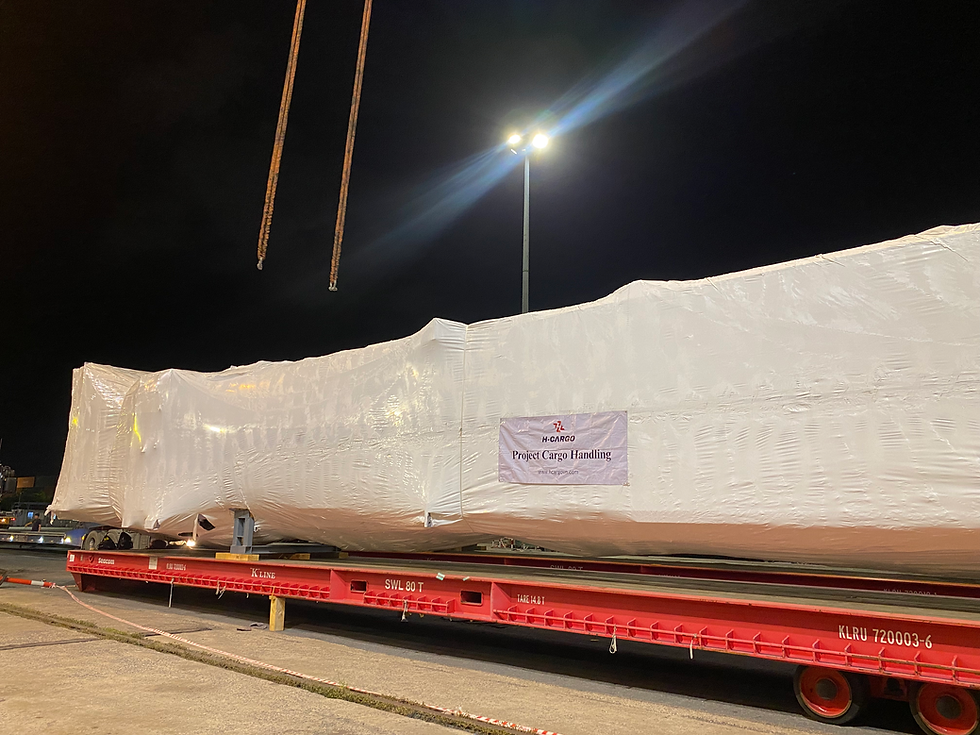
On a project to transport two large industrial steel tanks handled directly by the H-Cargo Project Team, the tanks exceeded the width and height of a standard container, but the total volume was not large enough to charter a dedicated Break Bulk vessel.
Instead of just booking a 40' Flat Rack for the sea leg and then using a conventional skeletal semi-trailer (with a deck about 1.4 to 1.5 m above the road, which can push the total height over bridge clearances and power lines), H-Cargo's engineers implemented an integrated solution right from the factory:
Dunnage & lashing calculation: the two steel tanks were placed on hardwood cradles to spread the load (avoiding point loads that would bend the Flat Rack floor), then secured in multiple directions with wire and rated straps in line with the IMO/ILO/UNECE CTU Code (MSC.1/Circ.1497).
Loading the whole 40' Flat Rack onto a lowbed trailer at the factory: the lowbed trailer lowers the center of gravity of the vehicle-and-cargo combination and keeps the overall height under control throughout the journey from the factory to the port of loading.
3 operational traps shippers must control before booking
Trap 1 — Exceeding Vietnamese road load and dimension limits while still "compliant" at sea: a 40' Flat Rack can carry 40 to 45 tonnes of cargo on a vessel. However, under Article 10 of Circular 12/2025/TT-BXD (amended by Circular 19/2026/TT-BXD, guiding the 2024 Law on Road Traffic Order and Safety), any indivisible package loaded on a vehicle that makes the combination (vehicle + container + cargo) heavier than 48 tonnes, wider than 2.5 m, taller than 4.2 m (4.35 m for container carriers) or longer than 20.0 m is classified as oversized and overweight cargo. The vehicle must then be a specialized trailer (lowbed or multi-axle hydraulic trailer), and a road circulation permit for oversized/overweight vehicles must be obtained before the cargo leaves the port.
Trap 2 — Ad-hoc lashing at the seller's warehouse (Shipper's Load, Stow and Count): when importing machinery on FOB or CIF terms by Flat Rack, many overseas suppliers lash only loosely with thin webbing or without rubber anti-slip mats between the machine's metal base and the steel floor. Under the CTU Code (MSC.1/Circ.1497), direct steel-on-steel contact has a very low friction coefficient, so the cargo shifts easily as the vessel rolls and the loading terminal may refuse the container at the gate.
Trap 3 — Customs clearance and cargo release at the destination port are not coordinated: cargo shipped by Break Bulk or OOG Flat Rack often needs a direct delivery plan (ship-to-truck or ship-to-barge) at the ship's side to avoid expensive storage and one extra risky lift. To make this possible, the customs documents for importing machinery and equipment and the quality inspection registration must be prepared 5 to 7 days before the vessel berths.
V. Frequently asked questions
Below are short answers from H-Cargo's project cargo team to the 4 practical questions shippers and supply chain managers ask most often when planning a shipment.
1. Cargo is only 10–15 cm wider on each side than a standard container: Open Top or Flat Rack?
It must go on a Flat Rack. An Open Top container has fixed steel side walls with an internal width of only about 2.34 m (door opening about 2.33 m). Any indivisible package wider than 2.30 m (after allowing safety clearance for loading) cannot be packed into an Open Top and must move to a Flat Rack.
2. Will cargo on a Flat Rack or on the deck of a Break Bulk vessel rust from salt spray?
The risk is very high without seaworthy packing. For precision machinery, electrical cabinets or machined metal surfaces shipped on a Flat Rack or on deck of a Break Bulk vessel, H-Cargo recommends vacuum foil bags with industrial desiccants, wrapped in heat shrink film or packed in a closed wooden crate before lashing.
3. How long does booking and preparation take for Flat Rack, Open Top and Break Bulk?
Allow about 7 to 14 working days before the vessel departure (ETD) for Flat Rack/Open Top, and about 15 to 30 days for Break Bulk, depending on the carrier and route. Unlike standard dry containers that can be booked 3–5 days ahead, OOG and Break Bulk cargo requires the carrier to check special equipment availability at the port of loading, approve the stowage & lashing plan, and verify crane capacity at transshipment and destination ports.
4. What information does H-Cargo need to compare Flat Rack and Break Bulk costs accurately?
Just send 5 basic items: (1) a detailed list of each package's dimensions (L x W x H) and gross weight; (2) technical drawings showing the center of gravity (CoG) and lifting & lashing points; (3) actual photos of the cargo or its packing specifications; (4) pickup and delivery locations (port or factory address for the inland route survey); (5) the required delivery schedule at site.
Related articles:
- Multi-axle hydraulic trailers & SPMT: when do you need them?
- Cranes, forklifts and lifting equipment for project cargo on site
VI. Conclusion
Choosing between Break Bulk, Flat Rack and Open Top is not just about checking which equipment the package fits; it requires balancing lost-slot surcharges at sea, lashing technique and inland road load limits.
To avoid terminal rejection or costs beyond budget, shippers should do three things as soon as they have a preliminary drawing: measure the dimensions and weight of each package along with its center of gravity; compare total costs including lost slots, handling and lashing, not just ocean freight; and survey the road route at both ends. Send your drawings and packing list so H-Cargo can propose a suitable project cargo transport or oversized and heavy cargo solution for your shipment.
Author: Navy Ngo - Project team
Contact us for a free consultation:
H-Cargo International Logistics
113-115 Ung Van Khiem St., Ward Thanh My Tay, Ho Chi Minh City
Tel: +84 888 909 186
Email: project@hcargovn.com
Web: www.hcargovn.com


Comments