


6-Step Project Cargo Transport Process: From Route Survey to Handover
The project cargo transport process has 6 steps: receiving and analyzing cargo information, route survey, applying for road permits, confirming the plan and signing the contract, organizing loading – lashing – transport, and finally unloading and handover at the site. This article explains each step in detail and the heavy-lift projects H-Cargo has completed in Vietnam.
Table of contents:
I. What Is Project Cargo?
Project cargo refers to high-value machinery, equipment or components, usually oversized or overweight, transported directly for construction and installation at industrial, infrastructure or factory sites.

Common project cargo groups:
Industrial machinery and equipment: wind turbines, boilers, tanks, transformers.
Oversized and heavy structures: bridge girders, steel structures, oil and gas pipelines.
Components and integrated systems: factory modules, airport passenger boarding bridges, production lines.
Every project cargo shipment is almost unique and often requires combining multiple modes of transport (sea, barge, road) to deliver the package to the exact installation position safely and on schedule.
II. What Are the Steps in the Project Cargo Transport Process?
H-Cargo applies a 6-step process to every project cargo shipment to control risks from preparation to handover:
Step | Main tasks | Output |
1 | Receive and analyze cargo information | Technical specifications, schedule requirements |
2 | Route survey | Transport plan (method statement) |
3 | Apply for road permits | Permits and operating conditions |
4 | Confirm the plan, sign the contract | Contract and implementation plan |
5 | Loading, lashing, transport | Cargo delivered to site |
6 | Unloading, inspection, handover | Inspection and handover report |
Step 1: Receive information and analyze cargo characteristics
This step determines the quality of the whole plan. H-Cargo collects drawings and technical data of the package: 3D dimensions (length x width x height), actual weight, center of gravity coordinates and lifting points. We also clarify the required lead time and site conditions at the pickup and delivery points.
Step 2: Route survey and transport plan
For oversized and overweight cargo, the route survey is the basis for selecting equipment and applying for permits. H-Cargo's field team reviews the route from origin to destination, focusing on:
Permitted load of bridges and culverts on the route.
Vertical clearance of power lines, signs, toll stations and overpasses.
Turning radii at intersections and access roads to factories and sites.
From the survey data, H-Cargo prepares a method statement: selecting equipment (lowbed trailer, hydraulic modular trailer or combined barge transport) and identifying points requiring road reinforcement, power line lifting or temporary removal of obstacles.
Step 3: Legal advice and road permit application
When a vehicle exceeds permitted dimension or weight limits, an oversize/overweight road permit is required under Vietnam's 2024 Law on Road Traffic Order and Safety and Circular 12/2025/TT-BXD. Based on the confirmed plan, H-Cargo prepares the application and fulfils the conditions stated in the permit, such as route, operating hours, pilot or escort vehicles.
Need a safe, on-schedule project cargo transport plan? Send your package details for H-Cargo's survey and advice.
Step 4: Confirm the plan and sign the contract
Once the technical specifications, plan and route have been assessed as feasible, H-Cargo and the customer review costs, agree on budget, schedule and liability terms, then sign the contract to execute the plan.
Step 5: Stevedoring, lashing and transport
This is the on-site execution step:
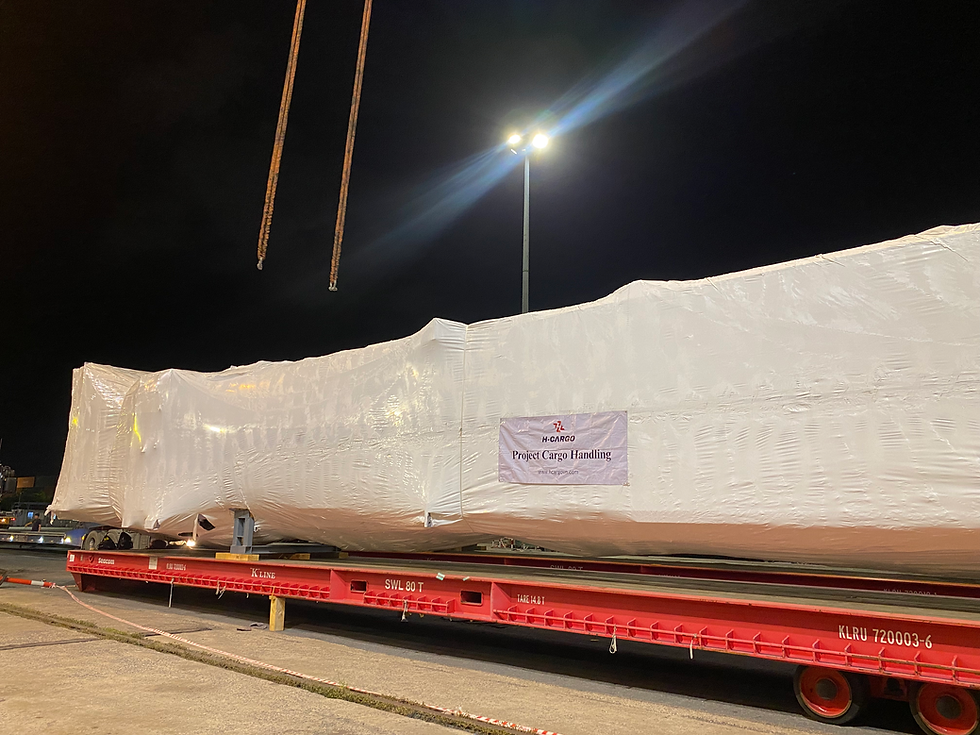
Stevedoring: deploying suitable cranes (shore cranes, crawler cranes, floating cranes) to lift cargo onto the vehicle, coordinating with the port and equipment rental providers.
Lashing: securing the package with steel wire ropes, load-rated chains, cribbing and corner protectors, calculated by weight and center of gravity to prevent shifting.
Transport: operating on the route and time windows stated in the road permit; the H-Cargo team supervises and coordinates escort throughout the journey.
Step 6: Unloading, inspection and handover at the site
On arrival at the site, H-Cargo coordinates placing the cargo on the foundation (if required) or into the laydown yard. Both parties inspect the cargo condition and sign the inspection and handover report.
III. Oversized and Heavy-Lift Projects Completed by H-Cargo
Some typical projects H-Cargo has carried out, from international freight and customs clearance to inland transport:
Airport passenger boarding bridge: transported a 130-tonne TK passenger boarding bridge (21 packages) from Santander, Spain to Noi Bai International Airport, combining international ocean freight, customs clearance and inland oversized haulage.
Hot-rolled steel plates: transported 770 tonnes of steel from Shanghai to Phu My (Ba Ria - Vung Tau).
Extra-heavy steel flanges: transported steel flanges from Lotus Port to Phu My Port by barge, optimizing cost for the shipper.
Oversized boilers: transported 2 boilers 4.3 m high from Cat Lai Port to Ben Cat, Binh Duong.
1,250-tonne crawler crane: handled customs procedures and clearance for a shipment of crawler cranes with 1,250-tonne lifting capacity for a wind power project in Vietnam.
Related articles:
- Oversized and Heavy-Lift (OOG) Cargo Transport: Regulations, Equipment and Loading Methods
IV. Frequently Asked Questions
How long does the project cargo transport process take?
It depends on dimensions, weight, route and permit processing time. Route surveys and permits usually take most of the preparation time, so businesses should contact us well before the required delivery date.
What information is needed to receive a project cargo transport plan?
Drawings or photos of the package, length x width x height, weight, center of gravity position, pickup and delivery points, and the required delivery date.
What is a route survey?
It is an on-site survey of the route to assess bridge load capacity, obstacle heights and turning radii; it is the basis for preparing the transport plan and applying for road permits for oversized and overweight cargo.
Does project cargo need a road permit?
Yes, when the vehicle exceeds the dimension or weight limits permitted on public roads. The permit may include conditions on route, timing and escort vehicles.
V. Conclusion
The project cargo transport process is a chain of 6 closely linked steps: accurate technical data, a thorough route survey, complete permits and suitable loading and lashing plans determine whether the shipment reaches the site safely and on schedule.
Before execution, businesses should do 3 things:
Prepare complete technical data: drawings, dimensions, weight, center of gravity, lifting points.
Survey the route early: to allow time for permits and obstacle removal.
Confirm the loading and lashing plan: lifting equipment, cribbing and lashing points for each package.
H-Cargo supports you from survey and planning to executing domestic and international project cargo transport. Send your package details to receive a suitable plan.
Author: Navy Ngo - Project team
Contact us for a free consultation:H-Cargo International Logistics
113-115 Ung Van Khiem St., Ward Thanh My Tay, Ho Chi Minh City
Tel: +84 888 909 186
Email: project@hcargovn.com
Web: www.hcargovn.com


Comments