


Project Cargo Lifting Equipment on Site: Crane or Forklift?
Project cargo lifting equipment should be chosen based on 4 key factors: package weight, lifting radius, ground bearing conditions and site access. Cranes suit high lifts, long-reach lifts and heavy loads, while forklifts suit loading, unloading and moving cargo over short distances on level ground.
Choosing the right lifting equipment not only keeps the job safe but also optimizes schedule and operating costs. This article explains how H-Cargo approaches equipment selection for each project.

Table of contents:
I. How do mobile cranes, crawler cranes and forklifts differ?
The main difference lies in how the equipment reaches the site and what kind of ground it can stand on.
Equipment | How it reaches the site | Strengths | Limits to know |
Mobile crane (truck crane, all-terrain) | Drives on public roads | Fast set-up, suits 1–2 day lifts | Must deploy outriggers; the load is concentrated on 4 points, so the ground must be able to bear it |
Crawler crane | Dismantled, transported on several trucks and reassembled on site | High capacity; can travel with a load on prepared ground | Time-consuming and costly to erect; needs space to assemble the boom |
Forklift | Delivered to site or already available at the factory | Flexible inside workshops and narrow aisles | Low lift height only; needs level ground; sensitive to off-center loads |
Under Circular 36/2019/TT-BLĐTBXH, cranes and engine-powered forklifts with a lifting capacity of 1,000 kg or more are on the list of machinery and equipment with strict occupational safety requirements, meaning they must be inspected before being put into use. Check that the regulation is still in force at the time of application.
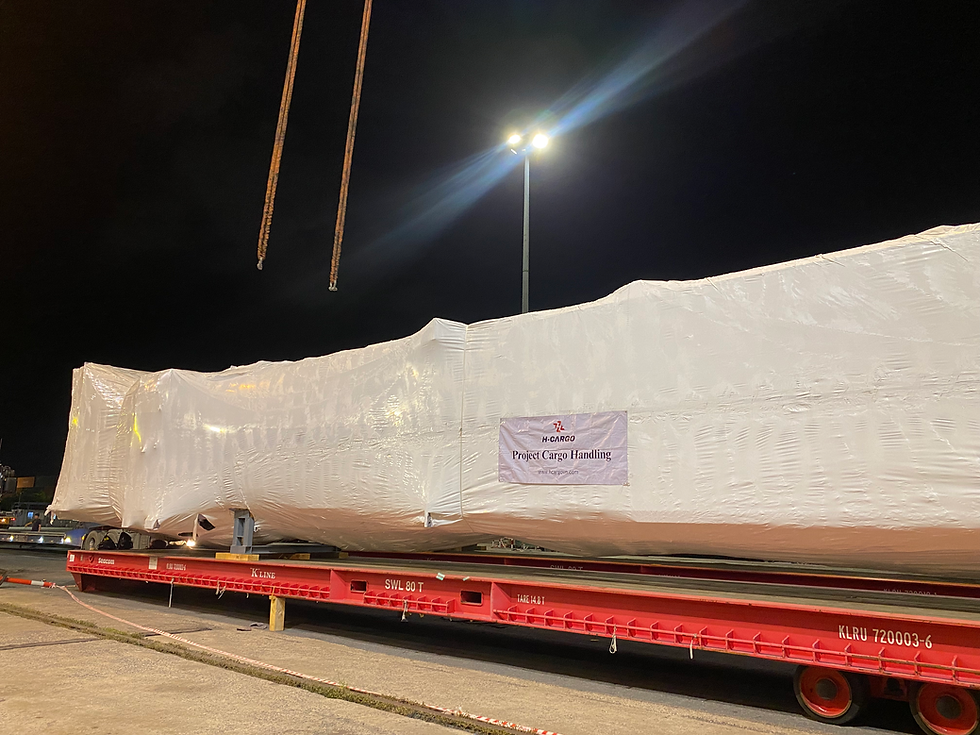
H-Cargo has handled a shipment of 1,250-tonne crawler cranes for a wind power project: about 1,790 tonnes and 5,161 CBM in total, from Changshu port (China) to Tan Thuan port. A crane of this size arrives on site as many separate packages, and assembling it requires an assist crane. So for short lifts and moderate packages, a mobile crane is usually the leaner option. A crawler crane makes sense when the package exceeds what a mobile crane can handle at the required radius, or when the crane needs to stay on site for several weeks.
II. Which criteria should you use to choose lifting equipment for project cargo?
A crane rental company needs the seven data points below to quote. Wherever data is missing, they usually add a safety margin, so a bigger crane is chosen and the price goes up.
Criterion | What you need to know | Where to get it |
Weight | Actual package weight, plus spreader frame, slings and shackles | Packing list, drawings, weighing ticket |
Dimensions & center of gravity | Length, width, height; center of gravity (CoG) position | Manufacturer drawings, CG marking on the package |
Lifting points | Number of lugs, positions, permitted load per lug | Drawings, equipment manufacturer |
Working radius | Horizontal distance from the crane's slewing center to the hook center at the pick and set positions | Measured on the actual site |
Site & ground | Soil, concrete or fill; any underground drains, tunnels or overhead power lines | Site survey, plant as-built drawings |
Access conditions | Gates, internal roads, turning radius, crane position and truck parking | Site survey |
Personnel & documents | Safety-trained operator, rigger and signal person; equipment inspection still valid | Lifting contractor's records |
Don't look only at the capacity on the quote; ask about the radius too. A crane's capacity drops as the radius increases, so a "100-tonne crane" on a quote does not mean it can lift a 100-tonne package in every position. The correct figure is in each crane's load chart, for a specific boom length and radius. Manufacturer lift planning software such as Liebherr Crane Planner also calculates the ground pressure under the outriggers for each slewing angle.
III. What should a lifting plan include?

A lifting plan describes, before the lift, what is being lifted, with which equipment, where it will be placed and who is responsible. A workable plan usually covers:
Package data: weight, dimensions, center of gravity, lifting points.
Equipment: crane type, boom configuration, radius, load chart capacity and load utilization.
Layout: drawing of the crane position, outriggers, mats, truck position and exclusion zone.
Rigging: the spreader frame, slings and shackles selected and the rated load of each item.
Personnel and signals: who operates, who rigs, who signals, and how they communicate.
Stop conditions: wind, rain, loss of visibility.
ISO 12480-1:2024 (Cranes – Safe use) has a dedicated section on planning crane operations and the roles of the operator, rigger and signal person. In Vietnam, technical safety requirements for lifting equipment are set out in QCVN 7:2012/BLĐTBXH. The maximum load utilization and the wind speed at which lifting must stop are defined by the lifting contractor in the lifting plan, based on the load chart and the crane manufacturer's recommendations.
IV. What are the steps of an on-site lifting operation?
The overall transport process is covered in our article on the 6-step project cargo transport process. The on-site lift itself consists of:
Step | Main tasks | Output |
1. Collect package data | Drawings, weight, center of gravity, lifting points | Package data sheet |
2. Site survey | Measure the radius, check the ground, access roads and overhead obstructions | Survey report with photos |
3. Select equipment, prepare the lifting plan | Choose crane/forklift, calculate loads, draw the layout | Lifting plan approved by all parties |
4. Prepare the site | Compact the ground, lay mats, fence off the lifting zone | Site ready |
5. Pre-lift checks | Inspection records, toolbox safety meeting, trial lift a short distance off the ground to check balance | Permission to lift confirmed |
6. Lift, set and hand over | Lift, lower into position, remove rigging | Handover record |
If there is no space for a crane, or the package has to go into a low-ceiling workshop, consider SPMT self-propelled modular transporters or multi-axle hydraulic trailers.
Related articles:
- Break Bulk vs Flat Rack vs Open Top: which option fits your shipment
- Transport with extendable trailers (telescopic semi-trailers)
V. Which mistakes most often delay a lift?
The following are illustrative examples of mistakes commonly seen in the industry:
Document weight missing accessories: the spreader frame and slings are left out, so the crane runs close to its load chart limit.
No ground survey: outriggers end up on a drain cover or freshly filled ground, so the crane has to be moved and the plan redone.
Cargo truck arrives before the crane: the truck waits at the gate and demurrage charges accrue.
Experience from shipments H-Cargo has handled: 1,250-tonne crawler cranes for a wind power project (about 1,790 tonnes, 5,161 CBM, from Changshu to Tan Thuan port); 7 machinery packages totaling 137.5 tonnes from Lotus port to Ben Cat, Binh Duong; 21 packages of airport passenger boarding bridges totaling 130 tonnes from Spain delivered to Noi Bai airport. For shipments like these, package data, the route and truck arrival times must be matched in advance with the unloading plan at the delivery point; otherwise the cargo sits waiting at the gate.
Have a package that needs to go from the port onto its foundation? Send us the drawings, weight and site photos, and H-Cargo will propose a lifting plan and heavy machinery relocation and installation solution for your shipment.
VI. Frequently asked questions
Can a 50-tonne crane lift a 50-tonne package?
Usually not. 50 tonnes is the capacity at the minimum radius. At the actual radius on site, capacity is much lower; check that specific crane's load chart.
When should you use a forklift instead of a crane?
When the package is within the forklift's rated capacity, the ground is level and firm, and the travel distance is short, for example moving machines inside a workshop. Tall or long packages, or those that must be set on a plinth, need a crane.
Who is responsible for preparing the lifting plan?
Usually the lifting contractor or installation contractor; the cargo owner and the coordinating company review and approve it before the lift.
VII. Conclusion
Choosing a crane or a forklift for project cargo does not depend on the capacity figure on the quote, but on actual weight, working radius, ground bearing capacity and site access. Before deciding, do 3 things: weigh the package including spreader frame, slings and shackles; measure the radius and survey the ground at the crane position; and finalize the lifting plan with the lifting contractor before the cargo truck sets off. The H-Cargo team coordinates from port to foundation and works with the lifting contractor on each project shipment.
Author: Navy Ngo - Project team
Contact us for a free consultation: H-Cargo International Logistics
113-115 Ung Van Khiem St., Ward Thanh My Tay, Ho Chi Minh City
Tel: +84 888 909 186
Email: project@hcargovn.com
Web: www.hcargovn.com


Comments