


Types of Trailers for OOG Cargo Transport: How to Choose by Payload and Number of Axles
OOG (out-of-gauge, oversized and overweight) cargo is usually carried on 4 groups of OOG cargo trailers: flatbed and extendable trailers for long cargo, lowbed trailers for tall cargo, multi-axle hydraulic modular trailers for very heavy cargo, and hydraulic steerable trailers for routes with tight bends. The right choice depends on the dimensions, weight and center of gravity of the package and the infrastructure along the route.
Table of contents:
I. Why Must Payload and Number of Axles Be Calculated for OOG Cargo?
For oversized and heavy-lift packages, the gross weight of vehicle and cargo must be spread over enough axles so that each axle load stays within the load capacity of the roads and bridges on the route. Correct distribution prevents damage to road structures, subsidence and local overloading of the trailer frame.
When a vehicle exceeds the permitted dimension or weight limits, the vehicle owner must obtain an oversize/overweight road permit under Vietnam's 2024 Law on Road Traffic Order and Safety and Circular 12/2025/TT-BXD. The permit specifies the route, permitted load and operating conditions, so the number of axles and trailer type must be confirmed before applying.
II. What Standard Trailers Are Used for OOG Cargo?
For moderately oversized and overweight packages, the following two trailer types usually offer the best cost efficiency:
1. Flatbed trailer and extendable trailer
A flatbed trailer has a flat deck about 1.5 m high and about 2.5 m wide. The most common length is 12 m, with 13 m, 14 m, 17 m and 18 m versions also available.
For very long cargo such as industrial steel pipes or bridge girders, an extendable trailer can be lengthened (up to about 23 m depending on the type) to support the full length of the package and limit rear overhang.
2. Lowbed trailer
When the height of the package is the main issue, a lowbed trailer is the right choice. It usually has a deck height of about 0.4 - 0.9 m and a width of about 3 - 3.6 m.
The dropped deck (U-shaped or a low flat deck) lowers the cargo's center of gravity and reduces the total height of vehicle and cargo, making it easier to pass under overpasses, toll stations and power lines on the route.

III. Which Trailers Are Used for Very Heavy Oversized Cargo?
For packages weighing hundreds of tonnes or more, conventional trailers are not sufficient and specialized equipment is required:
1. Hydraulic modular trailer
A hydraulic modular trailer consists of multiple axle modules coupled lengthwise and side by side. The hydraulic suspension balances the load across axles and raises or lowers the deck during loading and unloading. Common modular lines on the market come from manufacturers such as Goldhofer (Germany).
The technical axle load of hydraulic modules can reach about 45 tonnes per axle depending on the model; for example, a 6-axle module can theoretically carry about 270 tonnes, and coupling more modules increases capacity accordingly. On public roads, the actual load is further limited by the road permit and the load capacity of roads and bridges.
2. Rigid hydraulic trailer and steerable trailer
Rigid hydraulic trailer: fixed number of axles but with a hydraulic balancing system, suitable for long, heavy components such as airport passenger boarding bridges. See our project transporting a 130-tonne passenger boarding bridge from Spain to Noi Bai.
Hydraulic steerable trailer: the axles can steer independently, allowing long vehicle combinations to pass through junctions and tight bends where conventional trailers cannot turn.
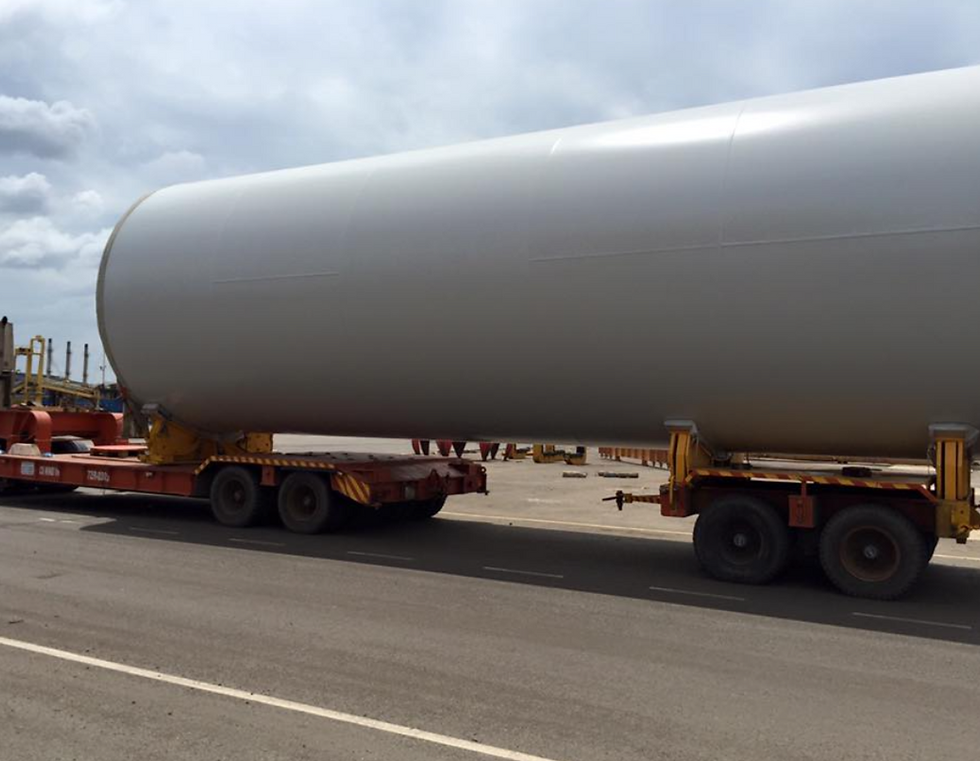
A wind turbine tower section placed on two separate axle bogies; the self-steering rear bogie lets the long combination negotiate tight bends where a conventional trailer cannot maneuver.
Related articles:
- 6-Step Project Cargo Transport Process: From Survey to Handover
IV. How to Choose a Trailer for OOG Cargo Transport
This summary table helps you quickly choose a trailer type based on the package characteristics:
Package characteristics | Suitable trailer type | Notes |
Long, not too tall | Flatbed, extendable trailer | Control the rear overhang |
Tall, need to reduce total height | Lowbed trailer | Check overpass and power line clearance |
Very heavy, weak roads/bridges | Multi-axle hydraulic modular trailer | Calculate axle loads against road and bridge limits |
Long, route with tight bends | Hydraulic steerable trailer | Survey turning radii in advance |
To choose correctly, H-Cargo assesses 3 factors:
3D dimensions and center of gravity (CoG): determine the deck width, cribbing and anti-tipping lashing plan.
Load capacity of roads and bridges: if roads or bridges are weak, a multi-axle trailer is needed to reduce the load per axle.
Route survey results: low overpasses call for a lowbed trailer; tight bends call for a steerable trailer.
H-Cargo works with a network of partner trucking companies and equipment rental providers to assign the right trailer to each package, instead of using one vehicle type for every shipment.
V. Frequently Asked Questions
What is the difference between a lowbed trailer and a flatbed trailer? A lowbed trailer has a lower deck (about 0.4 - 0.9 m) to reduce the total height of vehicle and cargo, suitable for tall cargo; a flatbed trailer has a higher deck (about 1.5 m), suitable for long, not-too-tall cargo.
When is a hydraulic modular trailer needed? When the package is very heavy or roads and bridges on the route have low load ratings, requiring many axles to distribute the load and a hydraulic system to balance and raise/lower the deck.
Is a permit required to carry oversized or overweight cargo? Yes. Vehicles exceeding permitted dimension or weight limits must have a road permit, with conditions on route, operating hours and escort vehicles where applicable.
What information should I provide for H-Cargo to recommend a trailer? Length x width x height, weight, center of gravity position, drawings or photos of the package, and pickup and delivery points.
VI. Conclusion
Choosing a trailer for OOG cargo transport is an engineering problem: flatbed and extendable trailers for long cargo; lowbed trailers for tall cargo; hydraulic modular trailers for very heavy cargo; steerable trailers for routes with tight bends. Choosing the wrong equipment can mean a permit is refused, the route must change or extra costs arise.
Before confirming a plan, businesses should do 3 things:
Provide complete package specifications: dimensions, weight, center of gravity, lifting points.
Survey the route: overpasses, bridge load ratings, turning radii.
Confirm the trailer type and number of axles before applying for a road permit.
H-Cargo analyzes drawings and proposes the right vehicle combination for each OOG package. Send your package details to receive a transport plan and quotation.
References: Vietnam's Law on Road Traffic Order and Safety 2024 (Law No. 36/2024/QH15); Circular 12/2025/TT-BXD; trailer specifications are indicative and vary by manufacturer and model. Accessed 08/10/2026. This article was AI-assisted and reviewed by an H-Cargo specialist.
Author: Navy Ngo - Project team
Contact us for a free consultation:H-Cargo International Logistics
113-115 Ung Van Khiem St., Ward Thanh My Tay, Ho Chi Minh City
Tel: +84 888 909 186
Email: project@hcargovn.com
Web: www.hcargovn.com


Comments