


Vietnam Import Procedures for Machinery and Production Lines (New and Used)
Vietnam's import procedures for machinery involve 5 steps: determine the HS code and the policy for the goods, prepare documents, file the declaration on VNACCS, inspection and duty payment, then clearance and moving the machines to the factory. Used machinery, disassembled production lines and machinery for projects have additional procedures.
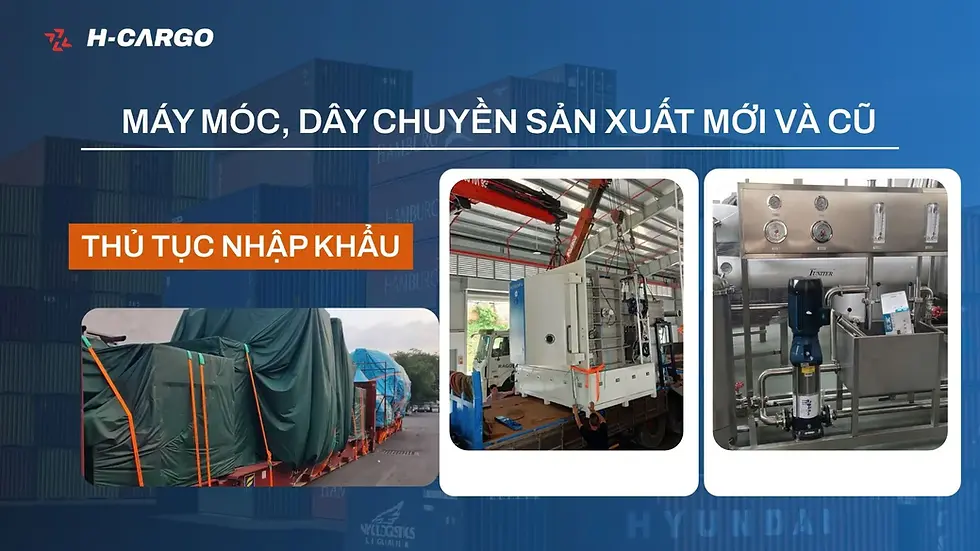
Table of contents:
I. Which HS codes apply to imported machinery and production lines?
II. Is imported machinery subject to specialized inspection?
III. Can used machinery and production lines be imported?
IV. What documents are needed to import machinery?
V. How many steps are in the machinery import process?
VI. How do you declare a production line imported disassembled in several shipments?
VII. Is machinery imported for a project exempt from import duty?
VIII. What to watch when moving machinery from the port to the factory
IX. Import procedures for specific types of machinery
X. Frequently asked questions
XI. Conclusion: 3 things to settle before importing machinery
I. Which HS codes apply to imported machinery and production lines?
Most machinery falls under Chapter 84 (mechanical machinery and equipment) or Chapter 85 (electrical machinery and equipment). The 8-digit code determines the duty rate and management policy, so the code must be settled before signing the contract.
For a production line consisting of several machines that together perform a clearly defined function, the goods are classified under the heading for that function according to Note 4 to Section XVI of the HS Nomenclature. Each machine does not necessarily have to be declared under its own code.

When unsure of the code, businesses can ask customs for an advance classification ruling under Article 28 of the 2014 Customs Law.
II. Is imported machinery subject to specialized inspection?
It depends on the 8-digit HS code of each machine. Licences, specialized inspection or specific conditions are all tied to a particular code, so there is no single answer for every type of machine.
The right approach: settle the 8-digit code, then check the management policy for that exact code at the time of import. Detailed procedures for each machinery group are in the table at the end of the article.
Related articles:
- Industrial boiler transport: technical solutions and import procedures
- Import procedures for coaches and buses: HS codes, vehicle inspection and taxes
III. Can used machinery and production lines be imported?
Yes, if they meet the criteria of Decision 18/2019/QD-TTg (effective 15/6/2019). Used machinery may only be imported to directly serve the enterprise's own production.
Criteria | Used machinery and equipment | Used technology lines |
Age / performance | Equipment age not exceeding 10 years | Remaining capacity or efficiency of at least 85% of design |
Consumption | – | Raw material and energy consumption not exceeding design by more than 15% |
Standards | Meets Vietnamese technical regulations (QCVN) on safety, energy saving and environment; where no QCVN exists, Vietnamese standards (TCVN) or national standards of G7 countries or South Korea | Meets QCVN on safety, energy saving and environment |
Technology | – | Not on the list of technologies banned or restricted from transfer; in use at at least 03 production facilities in OECD countries |
Documents and step-by-step guidance for used machinery are in the article on import procedures for used machinery.
IV. What documents are needed to import machinery?
The file consists of a basic set of documents, plus extra papers for used machinery, disassembled goods and duty-exempt goods.
Document | Required when | Legal basis |
Import goods declaration (VNACCS) | Every shipment | Art. 16 Circular 38/2015/TT-BTC (as amended) |
Commercial invoice | The buyer must pay the seller | Art. 16 Circular 38/2015/TT-BTC (as amended) |
Packing List, bill of lading (B/L) | Documents accompanying the shipment | – |
C/O | To claim special preferential FTA rates | The relevant agreement |
Catalogue, technical documents | To support the HS code and machine function | – |
Manufacturer's confirmation or inspection certificate | Used machinery and production lines | Decision 18/2019/QD-TTg |
List of machinery and equipment with a Deduction Tracking Sheet | Machine assemblies and disassembled production lines | Art. 16.2.i Circular 38/2015, amended by Circular 121/2025/TT-BTC |
Notified list of duty-exempt goods | Project duty exemption | Art. 30 Decree 134/2016/ND-CP (as amended) |
V. How many steps are in the machinery import process?
The process has 5 steps. How long step 4 takes depends on the channel assigned.
Step | What to do | Notes |
1. HS code, policy | Settle the 8-digit code, used machinery conditions, duty exemption | Do this before signing the contract |
2. Prepare documents | Per the documents table | Used machinery needs a manufacturer's confirmation or inspection certificate |
3. File on VNACCS | The system assigns a channel | Green: no inspection. Yellow: document check. Red: document and physical inspection |
4. Inspection, duty payment | Pay duty or provide a guarantee before clearance | Bulky machines selected for physical inspection need lifting equipment arranged at the port |
5. Clearance, take delivery | Move the goods out of the customs supervision area | Leg to the factory (see section below) |
A delay at any step adds container detention and storage charges. These extra costs are covered in the article what costs does delayed customs clearance cause.
VI. How do you declare a production line imported disassembled in several shipments?
A production line or machine imported disassembled is classified as a complete machine if the imported part has the essential character of the complete machine (Rule 2(a) of the 6 General Interpretative Rules).
In that case, the business submits a List of machinery and equipment with a Deduction Tracking Sheet (Art. 16.2.i Circular 38/2015/TT-BTC, amended by Circular 121/2025/TT-BTC). Each shipment is deducted on the sheet until the set is complete. The declaration approach should be settled from the first shipment.
VII. Is machinery imported for a project exempt from import duty?
Yes, if the goods form fixed assets of a project in an investment-incentive sector or location (Article 16 of the Law on Export and Import Duties 107/2016/QH13).
Prerequisite: the project owner must notify customs of the List of duty-exempt goods before registering the first duty-exempt declaration (Article 30 Decree 134/2016/ND-CP, most recently amended by Decree 182/2025/ND-CP, effective 01/07/2025).
If not eligible for exemption, machinery is subject to preferential (MFN) rates under the tariff schedule attached to Decree 26/2023/ND-CP (as amended), or special preferential rates with an FTA C/O.
VIII. What to watch when moving machinery from the port to the factory
Large machines usually travel in flat rack (FR) containers and need specialized trucks for the inland leg. Vehicles carrying cargo longer than 20 m, wider than 2.5 m, higher than 4.2 m (4.35 m for container trucks), or with a combined vehicle and cargo weight over 48 tonnes must obtain a road permit from the Department of Construction (Circular 12/2025/TT-BXD, consolidated in 26/VBHN-BXD).

A real H-Cargo shipment: 3 x 40' flat rack containers of machinery imported from China, discharged at Ho Chi Minh City port. H-Cargo trucked them from the port to the customer's factory in Dong Nai.
IX. Import procedures for specific types of machinery
Each machinery group has its own HS code and policy. The table below links to detailed articles for each type.
Machine type | Detailed article |
Used machinery | |
CNC machines | |
Agricultural machinery |
Need to import machinery, production lines or large equipment? Call H-Cargo now: +84 888 909 186.X. Frequently asked questions
How old can used machinery be to be imported?
No more than 10 years, under Decision 18/2019/QD-TTg. Used machinery may only be imported to directly serve the enterprise's own production.
What conditions must a used production line meet?
Remaining capacity or efficiency of at least 85% of design, raw material and energy consumption not exceeding design by more than 15%, and technology not on the list banned or restricted from transfer.
Does a production line imported in several shipments have to be declared machine by machine?
Not necessarily. It can be classified as a complete machine or functional unit, with each shipment tracked on a Deduction Tracking Sheet.
When is machinery imported for a project exempt from duty?
When it forms fixed assets of a project in an investment-incentive sector or location, and the project owner has notified the duty-exempt List before the first declaration.
XI. Conclusion: 3 things to settle before importing machinery
HS code and policy: settle the 8-digit code; check whether used machinery meets Decision 18/2019 criteria.
Declaration approach: whether the line is imported complete or disassembled over several shipments, and whether a Deduction Tracking Sheet is used.
Duty: whether the project qualifies for duty exemption and whether the exemption List has been notified.
These three points should be settled before signing the machinery purchase contract, not after the goods reach the port.
Author: Navy Ngo - Marketing Specialist
Contact us for a free consultation:
H-Cargo International Logistics
· 113-115 Ung Van Khiem St., Ward Thanh My Tay, Ho Chi Minh City
· Tel: +84 888 909 186
· Email: jack.tran@hcargovn.com
· Web: www.hcargovn.com
Sources cited: Customs Law 2014; Law on Export and Import Duties 107/2016/QH13; Decree 134/2016/ND-CP (amended by Decree 18/2021, Decree 182/2025); Decree 26/2023/ND-CP; Circular 38/2015/TT-BTC (amended by Circular 121/2025/TT-BTC); Decision 18/2019/QD-TTg; Circular 12/2025/TT-BXD (consolidated 26/VBHN-BXD). Accessed 03/11/2026. For reference only. Check that regulations and tax policies are in force at the time of application.


Comments